NFT history · · by Alex
CryptoKitties: the 2017 cats that clogged Ethereum, and why people searched them in 2021
The first NFT craze jammed Ethereum in December 2017 and sold a Genesis kitty for 246.93 ETH. In 2021 searches came back. Today the rare kitties trade twice a year at about 1 ETH.

CryptoKitties, the breedable cats launched on Ethereum in late November 2017, were the first NFT craze: within days they were a large share of all Ethereum traffic and the Genesis kitty sold for 246.93 ETH; in 2021 people searched for them again because the NFT boom sent everyone looking for where it started, and today the rare kitties we track change hands only a couple of times a year, at around 1 ETH. That is the short answer. The details are a good lesson in what "first" is worth in this market.
The cats that clogged Ethereum
CryptoKitties came out of Axiom Zen, a Vancouver studio, later spun out as Dapper Labs. The idea was simple and new: each cat was a token you really owned, and two cats could breed a third with its own traits. It went live on November 28, 2017, and the network was not ready. Quartz reported that by early December the CryptoKitties contract was the busiest address on Ethereum, handling close to 12% of all transactions, up from about 4% days earlier, and that pending transactions had risen about sixfold since launch. Estimates in other outlets went higher. Transactions slowed down, fees went up, and the developers had to raise their own prices to cope.
The money followed the traffic. The first sale in our books is the Genesis kitty, on December 2, 2017, for 246.93 ETH, about 113,660 USD at the time. In the next days BugCat went for 175.75 ETH and the cat known as SploitCat for 153.56 ETH and 128.42 ETH. The biggest kitty sale we hold came later: Dragon, on September 4, 2018, for 600 ETH, about 173,310 USD.
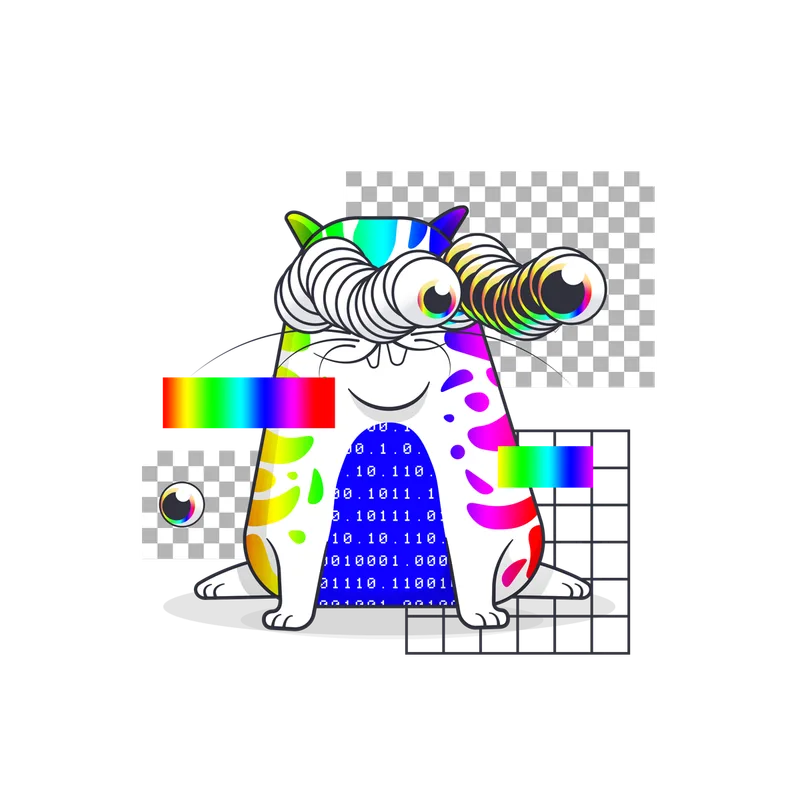
For context on how early this was: on December 2, 2017 CryptoKitties was one of only two collections in our books, and in June 2018 it held 99.6% of the NFT market cap we tracked. It was not a big fish in a pond. It was most of the pond.
What we actually track, and why it matters here
A warning before any numbers. There are 2,025,808 CryptoKitties in the original contract, and most of them were bred by players and never had a real market. Provenance tracks a selection of 348: the 347 Exclusive kitties, Genesis included, plus Dragon. Those are held by 165 wallets. Because a selection is not a market, we do not publish a floor for it; the arc of CryptoKitties is in its sales, not in a floor line.
Why people were searching CryptoKitties in 2021
When the NFT boom hit in 2021, the question "what was the first NFT game?" sent a lot of people back to the cats. A Design Bundles study of Google searches, with late 2021 data reported in March 2022, put CryptoKitties seventh among NFT projects with about 111,000 average monthly searches worldwide, ahead of CryptoPunks and Bored Ape Yacht Club in that same ranking.
The market for the rare cats did wake up, a little. Here is the selection we track, year by year:
| Year | Sales | Volume |
|---|---|---|
| 2017 | 5 | 835.52 ETH (375,226 USD) |
| 2018 | 21 | 832.40 ETH (258,106 USD) |
| 2019 | 32 | 212.50 ETH (36,159 USD) |
| 2020 | 35 | 132.85 ETH (40,383 USD) |
| 2021 | 62 | 379.93 ETH (870,614 USD) |
| 2022 | 3 | 3.82 ETH (6,207 USD) |
| 2023 | 4 | 3.32 ETH (5,746 USD) |
| 2024 | 9 | 6.75 ETH (19,605 USD) |
| 2025 | 1 | 0.33 ETH (740 USD) |
| 2026 (to date) | 2 | 1.94 ETH (4,668 USD) |
CryptoKitties: 174 sales in total from Dec 2017 to Sep 2026; busiest month Mar 2021 with 21 sales.
Source: Provenance, on-chain sales (wash trades removed), read when this page was served.
2021 was the busiest year these cats have ever had in our books, by number of sales and by dollars: 62 sales and about 870,600 USD, with a median price of 4.78 ETH. March 2021 alone had 21 sales, the busiest month we have for the selection, and on September 3, 2021 the kitty "#30 Furlin from Moonfarm" sold for 15.51 ETH, about 61,080 USD. Notice what the table really says, though: the ether volume of 2021 was less than half of 2017 or 2018. The dollars were bigger because ETH itself was worth far more. The cats were rediscovered, not repriced.
Where CryptoKitties is today
Since 2022 the market for the rare cats is close to silent: 3 sales in 2022, 4 in 2023, 9 in 2024, 1 in 2025 and 2 so far in 2026, those two at a median of 0.97 ETH. In the last 365 days the selection traded twice, for about 4,700 USD in total. And 99.7% of the 348 pieces have not moved in 90 days.
That is not a collapse in the usual sense. Nobody is dumping. It is a collection whose holders keep it as a piece of history and whose buyers, when one appears, pay around 1 ETH, in a selection whose first recorded sale, in 2017, was 246.93 ETH. The brand itself is not dead: in October 2026 the official account kicked off a "SpooKitty season" for Halloween and fans replied with themed cats.
What CryptoKitties proved is still the foundation of everything else on this site: that a token can be a collectible people care about, and that demand can overwhelm a blockchain. What it also proved is that being first does not hold a price. If you want to see where the market went after the cats, read our piece on CryptoPunks, the most searched collection of 2021, browse the selection on CryptoKitties, or see the record trades across every collection on NFT sales.
Data: Provenance (collection_stats_daily and the collection page; volume includes all recorded sales of the 348-piece selection), figures as of November 27, 2026.
Why this story: people searched for “CryptoKitties” during the 2021–2022 NFT bull market. A Design Bundles study of Google searches (late 2021 data, reported by City AM and Benzinga in March 2022) put CryptoKitties 7th among NFT projects, with about 111,000 average monthly global searches.
Prices and floors come from on-chain sales recorded by Provenance, wash trades removed. Not financial advice.